Hi, I’m Mark St. Cyr – Host and Founder of MYTR

After leaving the corporate world with many of the brass rings most people only dream about, including retiring at 45, I went on to write nearly two thousand articles and essays on business, markets, and judgment, along with two books that are now out of print. Much of that work was featured across the global media landscape.

The only reason this matters today is simple: it provides evidence that I may actually know what I’m talking about. But I don’t do that anymore. Here’s why.

Thanks for shipping, Mark

~ Seth Godin, Entrepreneur, Author, Teacher

People Are Looking For Answers
All They’re Finding Is Slop

Over the last few years, I’ve taken direct aim at what passes today for “motivation” and “success” in life and business. It’s a genre bloated with surface-level platitudes, performative optimism, and self-appointed experts who confuse volume with insight.

Unlike most voices dominating the web or the airwaves, I bring both the background and the temperament to back up what I say. My approach is direct by design and fully accountable, and it’s expressed through a program designed to challenge assumptions rather than comfort them — The MYTR Broadcast™.

My philosophy is simple: properly articulated, actionable advice has no boundaries. It should sharpen judgment, not dull it. It should never require spectacle, false urgency, or the suspension of common sense.

If you’ve read this far, you’ve already proven you are not the TL;DR type. I appreciate that because neither am I. For those who genuinely want to know more about me and why I do what I do, there are two ways to continue. The first is a formal biographical sketch, written for those who need the conventional corporate introduction. The second is a frank account, written by me, explaining what changed, when it changed, and why. It’s the best I can offer those who truly want to know.

A Biographical Sketch:

Mark St. Cyr is a recognized authority whose work spans global macro markets, Wall Street, finance, business, sales, motivation, and entrepreneurship. His writing and commentary have been featured or referenced by major media outlets, blogs, and newspapers around the world, reaching millions of readers.

Those outlets have included Reuters, Drudge Report, USA Today, MarketWatch, Sky News, ABC News, American Thinker, The Independent, ZeroHedge, CNNMoney, Seeking Alpha, Forbes CEO Network, Business Insider, Morningstar, China Daily, The Times of India, Belfast Telegraph, Slope of Hope, FindLaw, and Investing.com, among others.

Mark became known for identifying emerging risks across industries, often well before those risks entered mainstream discussion. His early warnings helped businesses and decision-makers recognize threats to capital, operations, and market position before the consequences became broadly acknowledged.

His experience also includes serving as a corporate liaison to the United States Department of Agriculture and helping pioneer company compliance programs for the NASA-inspired Hazard Analysis and Critical Control Point system, commonly known as HACCP.

Mark began his career at 18 and chose not to pursue formal higher education. Through direct experience, sustained effort, and demonstrated results, he rose to vice president of a multimillion-dollar corporation by the age of 23 and held his first chief executive position by 28.

His work in sales and management included developing new ethnic markets and directing an advertising campaign for one of the world’s largest global corporations. These experiences gave him a practical understanding of business from the operational level through executive leadership.

In 2012, Mark published his first book, A Fist Full of Markers, through StreetCry Media. It was released three days before Christmas without advertising, social media promotion, or a formal launch campaign. Within 24 hours, it had been downloaded in 13 countries. Within 72 hours, that number had expanded to more than 40.

That response reflected a pattern that would continue throughout his work: ideas traveling through relevance and reader recognition rather than through conventional promotion.
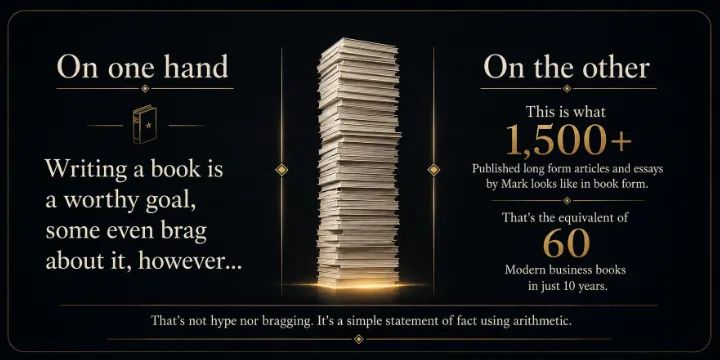
Mark has maintained little to no presence on social media. Even so, his writing continued to be cited, referenced, and circulated by major media outlets worldwide. Rather than relying heavily on traditional testimonials, he has pointed to that independent recognition as evidence that the work reached beyond his own claims about it.

After retiring at 45, Mark established his base in Lexington, Kentucky, known as the Horse Capital of the World. From there, he continues to write, speak, and host The MYTR Broadcast™, a live weekday program devoted to business, markets, judgment, motivation, and the issues affecting how people make consequential decisions.

His governing belief remains straightforward:

Properly articulated, actionable advice has no boundaries.

Now let’s address the 800-pound gorilla in the room.
Anyone searching for my earlier work may reasonably ask: If this person appeared across the media landscape for years, why does a search today reveal so little of it?
That is a fair question. Here is the answer.

The Disappearance


When you first arrived on this page, you may have noticed a quote attributed to The Washington Post. It is important to understand that the original characterization was not intended as a compliment.

It appeared in reporting that became part of a highly consequential media narrative emerging in late 2016, often associated with what became known as the Black Friday report and the broader allegations surrounding so-called “Russian propaganda.”

Whether history ultimately identifies one particular article as the catalyst is a matter for others to debate. What matters here is the outcome.

In the wake of that reporting, a small number of writers, including myself, found that years of published work, media citations, and archived material had effectively disappeared from public visibility. Earlier articles became difficult or impossible to locate through ordinary searches. At the same time, citing or republishing the work of those associated with the controversy became professionally risky for outlets that might otherwise have done so.

The practical effect was simple and lasting: more than a decade of published work became largely inaccessible, almost overnight.

That absence has never fully corrected itself.

In the years since, important aspects of the original reporting and the conclusions drawn from it have been publicly reconsidered and challenged. Even so, the downstream consequences remain. My present online footprint still reflects the residue of that period more accurately than it reflects the body of work that preceded it.

For that reason, when I refer to “the archives,” I am not speaking rhetorically. I retained records of what I published, where it appeared, and how widely it circulated. When necessary, I can produce that documentation. You will see examples as you continue reading.

This explains the gap many people notice, and rightly question, when searching for my earlier work today.

It is also the backdrop for everything that follows.

Why I Changed The Model


Now let’s turn to why I do what I do today.

Every day, we’re surrounded by screens competing for attention: large ones, small ones, and everything in between. Headlines announce the “most important story of the moment,” demanding urgency and reaction. Too often, what follows is little more than repackaged noise: attention engineered through provocation rather than insight.

It’s tempting to assume this problem belongs solely to social media. It doesn’t. In many respects, this is now the prevailing condition of mainstream business and financial media as well. Speed is rewarded. Volume is amplified. And certainty is treated as a substitute for judgment, whether real or manufactured.

I’m fully aware that this is a broad characterization. There are thoughtful, intelligent people working inside that system, many of whom I respect. But increasingly, meaningful dissent or nuance is filtered out unless it conforms to a narrow narrative of reassurance: that markets will rise, risks are manageable, and authority figures have everything under control.

That environment is not conducive to honest analysis.

For nearly two decades, my work existed squarely within that ecosystem. I wrote extensively on business, capital markets, central banking, Wall Street, technology, entrepreneurship, and motivation. Much of that work reached wide audiences through major media outlets around the world. At scale, that experience demonstrated something important: I had developed a disciplined understanding of the subjects I covered, tested in public.

But over time, it became clear that reach and effectiveness were no longer aligned.

Writing for mass distribution increasingly required compression, simplification, or concession: trading depth for immediacy, and clarity for shareability. That tradeoff no longer made sense to me. So rather than continue producing work for a system that discouraged sustained thought, I chose to change the model entirely.

That decision brings us to why you’re here.

What MYTR is and Isn’t


In December of 2019, I made a deliberate decision to stop publishing for mass media and mass audiences. In its place, I built something fundamentally different: The MYTR Broadcast™.

It is recorded live, daily, Monday through Friday. There are no guests. No callers. No commercials. Just me, the audience, and the subjects I believe genuinely matter in business and life. Often, an entire program is devoted to a single topic, examined in depth rather than rushed through for the sake of variety or momentum.

I don’t do “news” for news’ sake. I don’t do politics as theater, either. When legislation or policy is discussed, it’s only in terms of what it actually means: practically and concretely, for business, markets, and individual decision-making. I leave the personality contests and sound-bite debates to others.

The audience here is global. They come from different industries, different countries, and different stages of professional life. What they share is not ideology or background, but intent. They are looking for information and insight they can use, not affirmation, distraction, or slogans.

The format itself reflects that intent. I have found no other program currently delivering uninterrupted, host-driven analysis at this length, live, five days a week. Strip away commercials, traffic, weather, callers, and guest segments from most long-form shows and you’re left with surprisingly little substance. I know this because I’ve measured it.

MYTR is structured as a direct conversation between the listener and me: sifting through what matters, discarding what doesn’t, and arriving at conclusions most never reach because they’re never given the time or space to think them through.

Which leads to the only question that matters:

Is this for you?

Here’s the answer most won’t give: it isn’t for everyone.

Subscribers here tend to differ widely in scale and circumstance, but they share one defining trait: they take direct responsibility for their own outcomes. Their work, their decisions, their families, their futures. I refer to this mindset as The Business of I.

Within this community, discussion assumes adulthood in the original sense of the word. Ideas are examined without theatrics. Disagreement is expected. Being “triggered” is not a feature, it’s a signal that something else may be at work.

If certain foundational statements about history, markets, or human behavior feel intolerable rather than debatable, this likely isn’t a good fit. And that’s fine.

But if you’re looking for a place where the focus is on what’s actually happening, why it matters, and how to think about it clearly, without pandering or pretense, then MYTR may be worth your time.

If so, you can explore the options below.
And if not, I genuinely wish you well.

— MSC